
How many watts for your grow box?

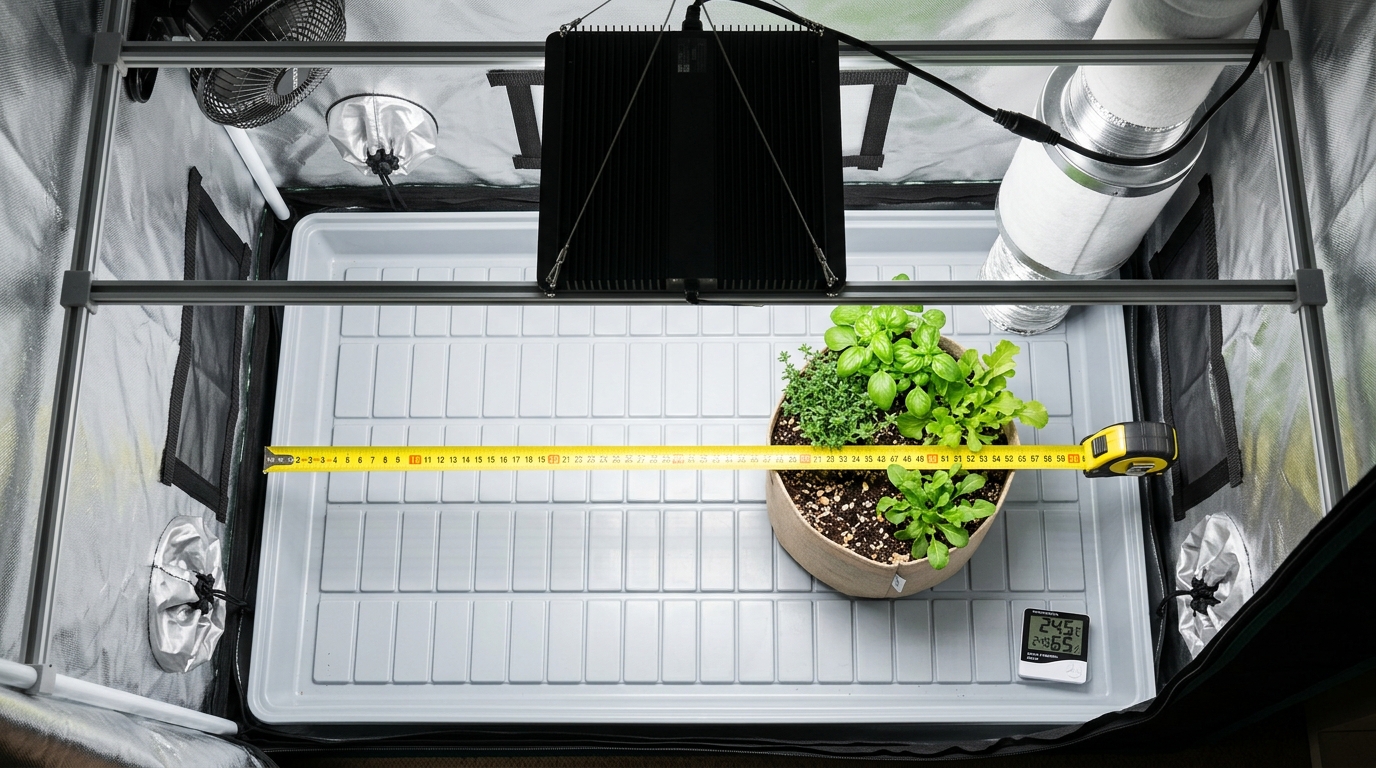
How many watts for your grow box? The definitive formula
60×60, 80×80, 100×100, 120×120 cm. Which lamp for each grow box size, with the formula to calculate it yourself.
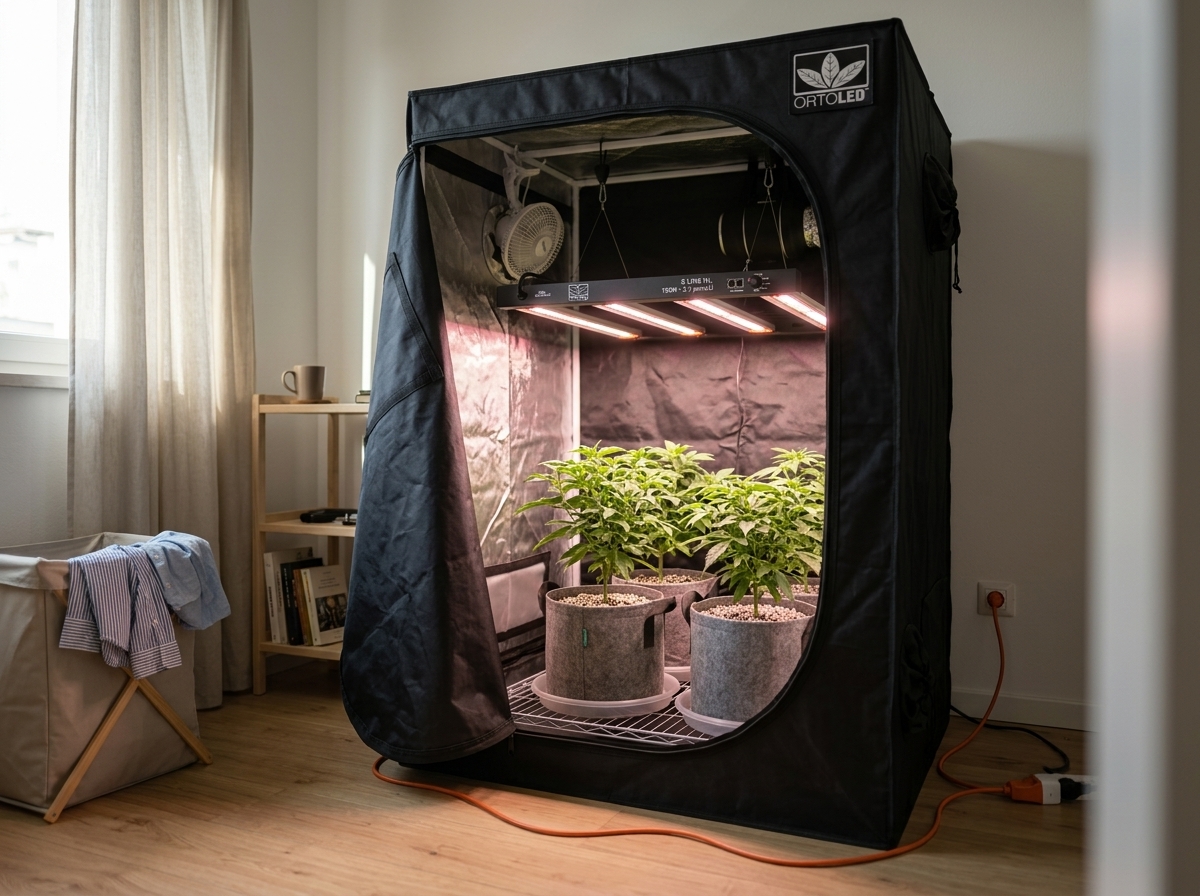
It’s the first question anyone setting up a grow box asks: how many watts do you actually need? The honest answer is that wattage alone isn’t enough — the lamp’s efficiency matters too — but you still need a solid starting point.
In this article you’ll find a practical formula and a table for the most common sizes, calibrated on efficient LED lamps with Samsung chips, not on the old criteria designed for HPS.
Just keep one thing in mind as you read: two lamps with the same wattage can deliver very different results if their µmol/J isn’t the same.
The base formula: watts per square meter
With efficient LED chips, above 2.7 µmol/J, you need roughly between 150 and 200 W/m² during the vegetative stage and between 200 and 280 W/m² during flowering to reach the PPFD targets covered in our guide on PPFD and DLI.
These figures are lower than the criteria used with HPS or with less efficient generic LEDs, precisely because a better chip produces more usable photons with less energy consumed.
Recommended watts by grow box size
Here’s a reference table for the most common sizes, calculated on an average flowering target of around 200 W/m² for high-efficiency lamps such as the Quantum Board EVO range for compact tents or the S Line Foldable for medium-to-large tents.
| 60×60 cm (0.36 m²) | 70–100W |
| 80×80 cm (0.64 m²) | 120–150W |
| 100×100 cm (1 m²) | 180–220W |
| 120×120 cm (1.44 m²) | 280–320W |
| 150×150 cm (2.25 m²) | 420–480W |
Indicative values for flowering with high-efficiency full spectrum lamps, without supplemental CO₂
When you need a higher wattage
If you supplement CO₂ above 1200 ppm, the plant can use more light without saturating photosynthesis, and in that case it makes sense to move toward the upper part of the range, or even beyond it, to make the most of your CO₂ investment.
The type of crop matters too: plants with high light demand during intensive flowering can benefit from values closer to the upper limit, while leafy crops or shade-tolerant plants do well at more moderate values.
Don’t trust the watts printed on the box alone
Two 300W lamps can perform completely differently if one has a 1.8 µmol/J chip and the other a 2.9 µmol/J chip. Use this table as a starting point, then always check the declared µmol/J before choosing a specific model.
Watts for a grow box in one sentence
With efficient LED lamps you need roughly 150-200 W/m² during vegetative growth and 200-280 W/m² during flowering. For a 100×100 cm grow box, that means a lamp between 180 and 220W, provided the chip has an efficiency above 2.7 µmol/J.
Before buying, always measure your tent in actual square meters — don’t rely on guesswork. An error of just a few centimeters on the sides changes the calculation more than you’d expect.
Still unsure about sizing?
Is it better to use one big lamp or two small ones for the same area?
Does the calculation change for a rectangular grow box?
Can I undersize the setup to save on the purchase?
Does the table also apply to the vegetative stage?
PPFD and DLI: the two values that determine your harvest
Without understanding PPFD and DLI you’re growing blind. A complete guide with practical examples.
How far should LED lamps be from your plants?
Distance affects PPFD, leaf temperature and light uniformity. Here are the practical rules.
How much do you save switching to LED? Real bill calculation
With current energy prices, the return on your LED investment is faster than you’d think.
Ready to switch to
professional LED?
Discover the ORTOLED range — lamps with Samsung chips tested for yield, efficiency and durability.


